
Managing maintenance across multiple villas or lodges
Most villa software is built around bookings, not buildings. Here is how to run maintenance across multiple separate sites without holding it all in your head and a WhatsApp thread.
Eight villas. A head of maintenance, two technicians, and a groundskeeper shared across all of them. Villa 3 has a pool-heater fault reported by housekeeping at 7am. Villa 6 has a guest arriving at 2pm and an outstanding snag from the last turnover: a shower thermostat partially fixed, needing a follow-up part. Villa 1 has a routine AC filter service scheduled two weeks ago that keeps getting pushed. The maintenance manager is holding all of this in his head, in a WhatsApp thread, and in a shared note on his phone.
By 11am, the technician sent to Villa 6 has fixed the pool heater because the message was unclear about which property the fault was in. The guest arriving at 2pm walks into a shower that still runs cold. This is not a staffing problem. It is a property maintenance management problem — what happens when villa management software is not built for the physical reality of running multiple separate sites.
Why multi-property maintenance is structurally harder than it looks
Single-property management has a natural anchor: everyone knows the building, location ambiguity is low, coordination happens in person, and the maintenance history lives in the heads of the people who did the work. Multi-property management removes all of those advantages. Each property is a separate physical environment with its own floor plan, equipment inventory, service schedule, and defect history. A technician rotating across eight villas cannot hold the spatial context of each one.
The failure mode is predictable. Jobs get assigned without enough location context, so they go to the wrong place. Follow-up work gets missed because it was logged verbally and never recorded. Parts arrive and sit in a storeroom because no one connected the delivery to the job. Guest-facing issues that should be Urgent get treated at the same pace as routine maintenance because there is no visible priority structure across the portfolio.
Most villa management software is designed around bookings, not buildings.
It tracks guests, calendars, and revenue. Maintenance is an afterthought — a to-do list attached to a booking platform, with no concept of floor plans, no spatial organisation, no procurement tracking, and no audit trail.
How Map My Maintenance handles a multi-property portfolio
The architecture starts with Sites. Each villa or lodge is set up as an independent site within the same account, with its own floor plan, team assignments, notification settings, and complete list of work, projects, and purchases. Nothing bleeds between properties. The site manager for Villa 3 sees Villa 3; the head of maintenance can see all of them. Switching between properties takes one tap from the dropdown at the top of the app, and each site loads its own data independently.
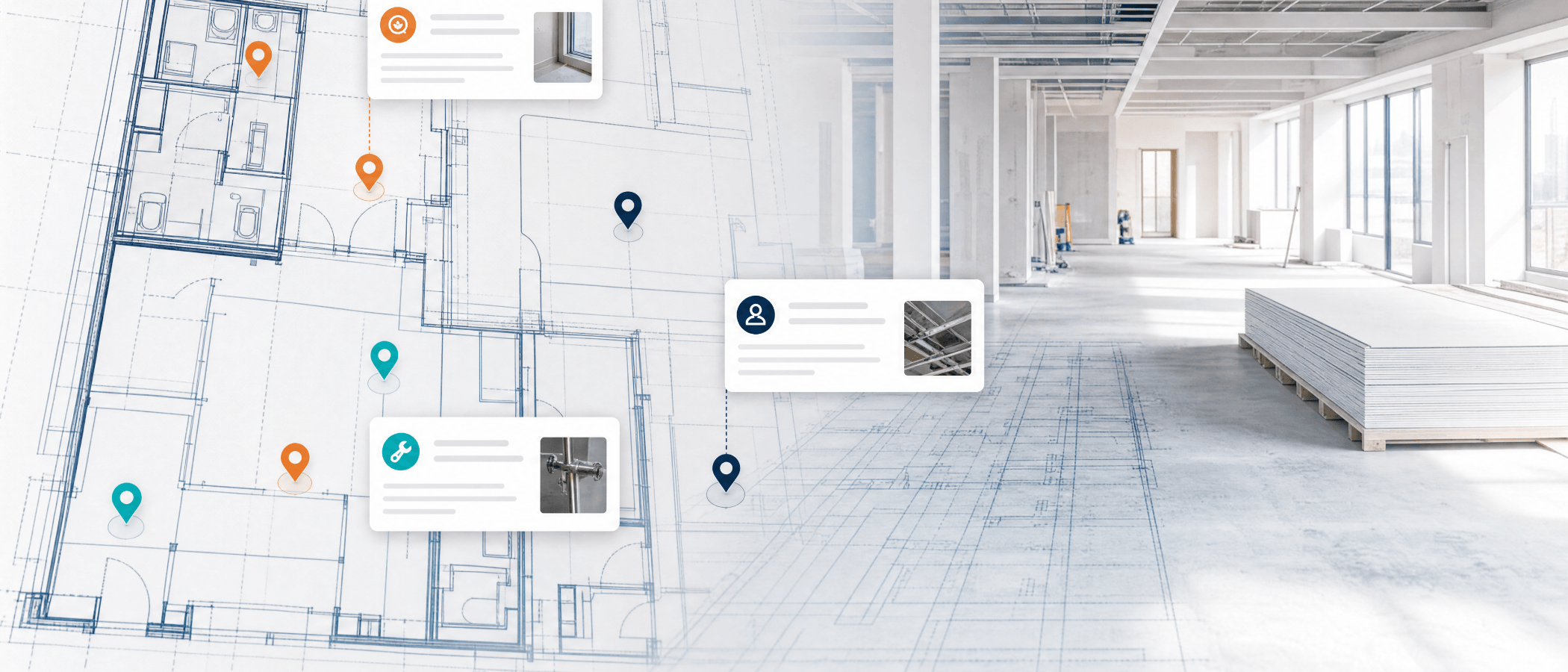
Within each villa, Area Setup provides the spatial layer. The actual floor plan is uploaded and each space is mapped and named — master suite, guest rooms, kitchen, plant room, pool equipment area, terrace, staff entrance — with location markers for specific points such as the boiler, the AC unit, the shower, the pool heater. When a technician opens a job on the mobile app, they tap View Location and the floor plan opens with the precise point highlighted. The plan does the briefing.
The Work List handles all internal maintenance, every item carrying a priority (Urgent, High, Medium, Low), a status, assigned personnel, proposed dates, and its pinned location. The Annotation Tool marks up a photo of the fault with a description, proposed solution, and materials required, and that annotated image travels with the job. For external trades, the Project List carries items through a defined status workflow with every change timestamped in the Activity Log. Special Purchases links every order to the job and location that needs it, with the OCR Tool reading part numbers from a label, and Reminders surface cyclical services on the Dashboard on the right day. The Timeline and Follow-Up Gantt view plots every open job, project, and purchase across the portfolio.
The jobs that cost the most
The failures that cost villa operators most are the follow-up jobs noted verbally after the first visit and never recorded — the part ordered but never connected to its job, the service deferred until it became a compliance issue. Invisible in a flat list; visible in a system where every job has a location, a status, and a reminder.
What a working week looks like across eight properties
Monday morning, the head of maintenance opens the account and checks the Dashboard for each site in sequence. Villa 3 shows one Urgent item (the pool-heater fault), two High, four Medium. Villa 6 shows one High item flagged with a Reminder due today: the shower thermostat follow-up part, which arrived Friday and was logged against the Special Purchase linked to the original job. Villa 1 shows a Medium item Paused for three weeks: the AC filter service.
The pool-heater fault is assigned to a technician with a Work List item pinned to the pool equipment area on the Villa 3 plan, including an annotated photo taken by housekeeping. No briefing call needed. The shower thermostat job in Villa 6 is updated to Progressing; the Special Purchase shows the part delivered; the technician attends before the 2pm arrival, and on completion the Activity Log records the timestamp, the technician, and the images. The AC service in Villa 1 is reassigned a start date, moved to High, and a Reminder is set. By end of day, three issues across three properties are resolved without a single coordination call, without ambiguity about location, and with a full record of every action.
The thing portfolio managers find out too late
The maintenance problems that cost villa operators the most are not the big, obvious failures. They are the follow-up jobs noted verbally and never recorded, the part ordered but not connected to the job, the service deferred until it became a compliance issue. The value of villa management software built around the physical layout of each property is not speed. It is continuity. When a technician leaves, the knowledge they carried does not leave with them. When an owner asks for a full maintenance history, it is already there.